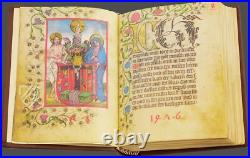







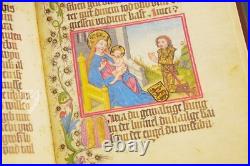






Waldburg Prayer Book, Facsimile Edition published 1986 by Deuschle & Stemmle – Darmstadt, in a limited edition of 600 (this is copy number 23) in an embossed leather cover. 122 pages / 17.5 × 13.2 cm. The Waldburg Prayer Book is one of the few richly decorated prayer books in German and was created in 1476 for the Swabian nobleman George II of Waldburg (1430-82) and his wife, Countess Anna of Kirchberg ca. Little is known about the origin of this manuscript, and its ownership history can only be traced back to around 1800. The only certainties are the manuscript’s patron, George II of Waldburg (1430-82), and the year of its completion, 1476. It is not known how the manuscript came to be in Stuttgart or Ludwigsburg, where Duke Charles Eugene of Württemberg founded the Ducal Library in 1765. Thus, the entire period from 1476 to the late 18th century remains a mystery. The manuscript’s original binding was replaced sometime in the first half of the 19th century by the present binding, whose simple appearance betrays the value and significance of its contents: a masterfully illuminated, uniquely designed German prayer book from the early days of the Northern Renaissance. In addition to depictions of religious figures and symbols, including the Arma Christi, George II of Waldburg is depicted several times, usually kneeling before a saint. Once, however, he also appears as his namesake: Saint George slaying a dragon. A total of 46 mostly full-page miniatures, seven historiated initials, and dozens of three- and four-line initials in bright colors and gold. Unlike most prayer books, this manuscript does not have a calendar at the beginning of the codex, but the Litany of All Saints, which begins on fol. 64r, has an internal structure consisting of chronological blocks arranged according to the church year, which is absolutely unique for a litany. There is further evidence for the manuscript’s geographical provenance: among the no fewer than 178 saints listed in the manuscript, divided into apostles, martyrs, confessors, and women, is Saint Magnus of Füssen, the so-called Apostle of the Allgäu. He was greatly venerated in the area around Waldsee, where George II resided, which indicates the Allgäu in Upper Swabia. This is also evidenced by the fact that Magnus was the patron saint of the nearby Premonstratensian monastery of Schussenried. Other local saints include Bishop Gebhard of Constance, Bishop Narcissus of Augsburg, the hermit Saint Meinrad, and the rarely mentioned Ulrich of Zell. The work must therefore have been created in an area where the old dioceses of Constance and Augsburg overlap. A possible place of production would therefore be a studio or a court artist in the town of Kempten, the oldest urban settlement in Germany.